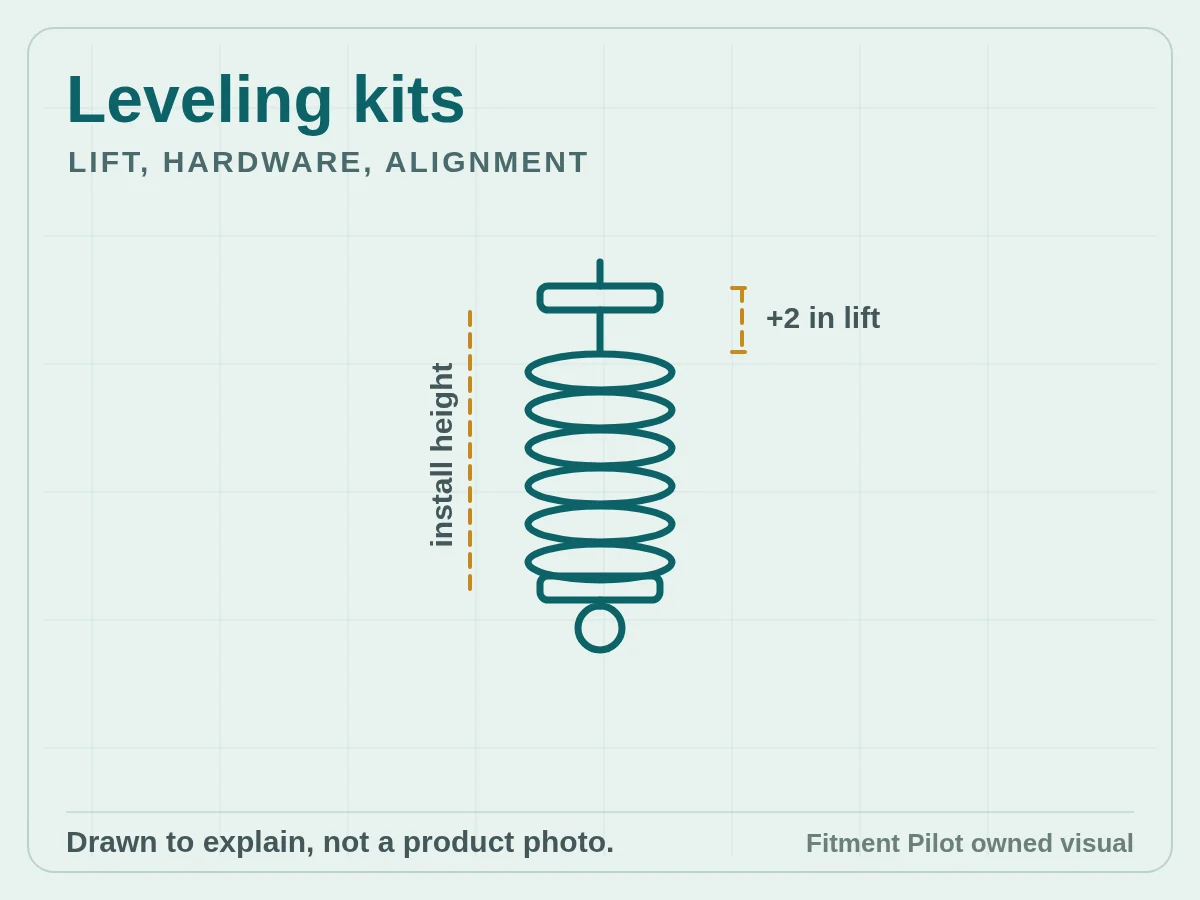
Use this shelf to compare lift height, suspension package, drivetrain, tire clearance, and warranty tradeoffs before choosing a kit. Several high-value rows still need stronger seller depth or fresher checkout checks, so the page keeps the verification work visible before the seller link.
Leveling-kit checks before choosing hardware
Match model year, cab, drivetrain, suspension package, and advertised lift height.
Leveling-kit checks before choosing hardware
Check whether the kit changes alignment, control-arm angle, shock length, tire clearance, or warranty terms.
Leveling-kit checks before choosing hardware
Confirm included hardware, install notes, stock, shipping, and return terms on the seller page.
How many inches a leveling kit should add is a measurement question, not a universal two-inch answer. A leveling kit raises the front of a truck to reduce factory rake - the unloaded nose-down stance that decreases as the rear settles under cargo or tongue weight. Many kits are marketed around 1.5 to 2.5 inches up front without changing rear ride height, but the exact kit specification and the wheel-and-tire plan it supports should control the purchase. The factory-rake measuring guide shows where to start. If you want the whole truck taller or need room for a much larger tire, compare lift kits instead; that distinction matters on a daily driver.
Compare what each kit reuses or replaces, not height alone. On strut-equipped trucks, common choices include top spacers, preload spacers, and loaded struts. Torsion keys fit only torsion-bar front suspensions. Loaded struts replace the strut assembly; height-adjustable struts or coilovers may add height adjustment, while only some coilovers add adjustable damping. Keep the shock, spring, bracket, mounting hardware, and wheel clearance within the kit's application notes; a height number alone does not establish clearance. As height increases, verify alignment range, upper-control-arm clearance, and - on independent-front-suspension 4WD trucks - CV-joint angle.
Before buying a leveling kit, measure factory rake on level ground, confirm the kit application and included hardware, and check the wheel-and-tire plan, clearance, and post-install alignment requirements. Budget a truck leveling kit by the installed total, not the box price alone. The total can include the kit, application-specific hardware, shop labor, alignment, and freight; the leveling-kit cost guide breaks those pieces out. Measure on level ground before ordering because trim, factory packages, and installed cargo can change rake. Record the suspension height and alignment baseline, then compare the final wheel and tire position after installation. Use the front-versus-rear leveling guide to decide which end fits the stance goal and the buying leveling kits online guide for the measurements and kit details to record before ordering. Plan for a post-install alignment, an immediate rubbing and loose-hardware check, and the kit maker's specified re-torque or reinspection interval.
Common questions
Do you need an alignment after a leveling kit?
Yes. Raising the front can change caster, camber, and toe. Have the alignment checked and adjusted to the truck's specifications; if it is out, symptoms can include pulling, uneven tire wear, or an off-center steering wheel.
Is a leveling kit front or rear?
Most kits raise the front to reduce factory rake. Rear lift blocks or lift shackles raise the rear instead; some kits include rear parts, so check the application and included hardware.
Should I get a 2-inch or 2.5-inch leveling kit?
Measure factory rake and follow the kit maker's tire-and-wheel notes. An extra half-inch may add clearance, but on independent-front-suspension 4WD trucks it can also steepen CV-joint angles and reduce alignment margin. If the planned tire fits with 2 inches, stop there.
Will a leveling kit affect towing or payload?
It does not increase the truck's published tow or payload ratings. Raising the front can change loaded stance, hitch setup, and headlight aim, so recheck them after installation.
What does a truck leveling kit cost installed?
There is no single installed price. Start with the exact kit and application-specific hardware, then add the installer's labor, any alignment work, and freight. Compare that quote with the kit instructions and the leveling-kit cost guide before treating a parts listing as the delivered total.
What should I check before buying a truck leveling kit?
Before ordering, confirm the exact truck, factory rake measurement, kit application and included hardware, intended wheel-and-tire combination, and the maker's clearance and alignment notes. A 2-inch label is not a universal fit; use the [buying leveling kits online guide](/guides/buying-leveling-kits-online) for the measurements and kit details to record before ordering.
Top parts
Seller links may earn Fitment Pilot a referral fee. Fitment guidance and deal quality come first.
Every product page carries seller choices, stock notes, and return-policy checks; prices below are recorded lows.
Compare fitment details, product picks, and seller choices.
$529.99
Privacy choices
Cookie choices
Fitment Pilot uses necessary browser storage for saved vehicle choices and site operation. Optional analytics helps us understand which fitment guides are useful. Optional advertising allows approved AdSense requests. Choose what you allow; you can change it later from Cookie settings.
Optional storage
Necessary storage is always on. Optional choices apply to this browser and can be changed later.
AdSense is currently configured conservatively: when enabled, the site requests non-personalized ads. Personalized ads require an appropriate Google-certified consent platform in some regions.