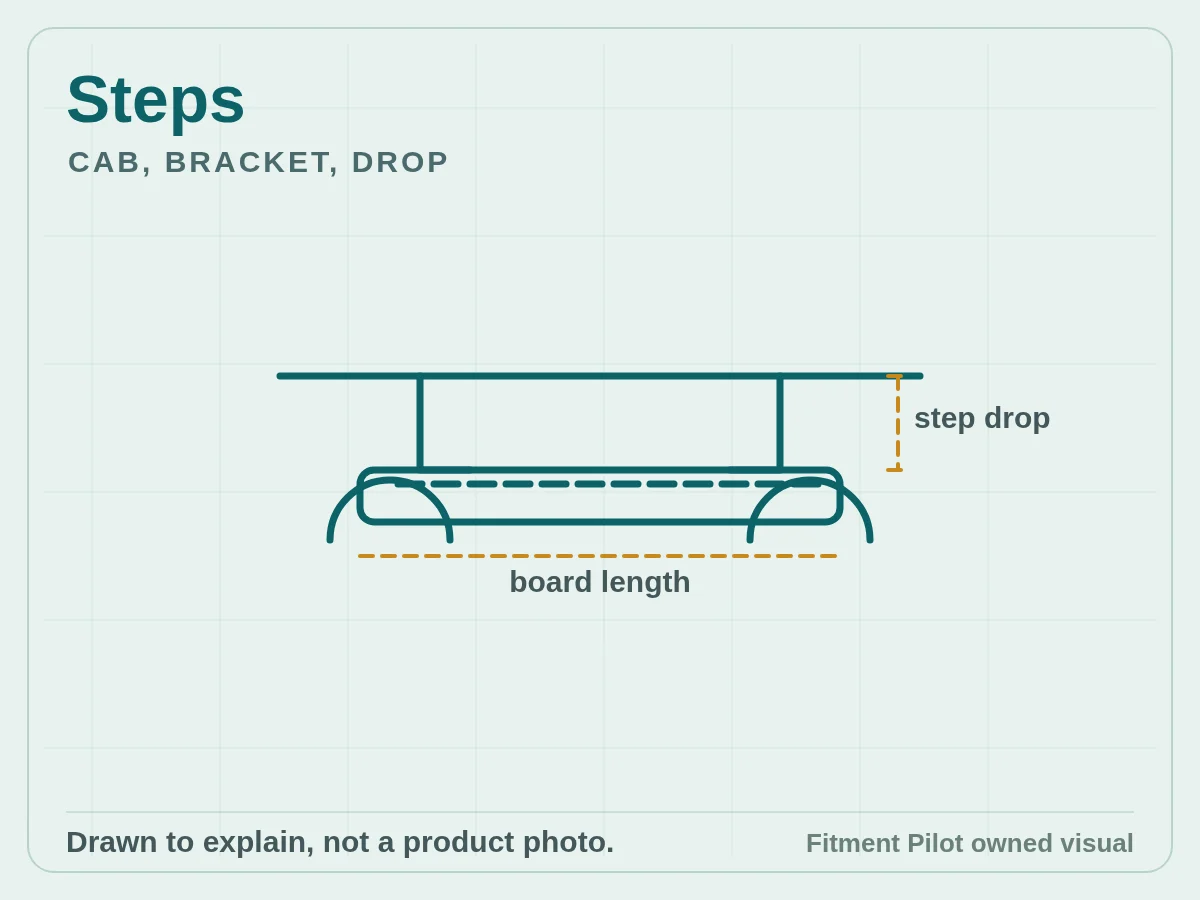
Running boards are sized by cab configuration and use application-specific body, rocker, pinch-weld, or frame mounting points. A crew cab, double cab, and regular cab all take different lengths and bracket sets - running boards and side steps covers cab length, brackets, and rocker mounting.
Decide what the step is for. A wider tread can make daily entry easier, while ground clearance depends on the step's mounting height and drop. Confirm the bracket kit matches the exact cab, and check whether the truck already has factory mounting points.
Fixed boards are the simple path; power-deploying boards tuck up for ground clearance but add motors and wiring; drop steps trade a lower step-in for less clearance off-road. Most modern kits bolt to factory mounting points, so check whether the listing says no drilling for the exact cab and bed combination.
Common questions
Do running boards fit any cab?
No. Length and bracket spacing are cab-specific - order by cab configuration, not by model year alone.
Will they reduce ground clearance?
Clearance depends on the brackets, mounting height, and step drop, not width alone. Check how far the assembly sits below and outside the rocker.
Do running boards require drilling?
Many vehicle-specific kits use existing mounting points, while others require drilling. Check the installation instructions for the exact truck configuration.
Are power steps worth it over fixed boards?
Power steps tuck up for ground clearance and drop lower than a fixed board when open, which helps taller trucks and shorter passengers. The trade is cost, motors, wiring, and moving parts in road salt and mud. Fixed boards have nothing to fail and no draw on the electrical system.
Will running boards fit a lifted truck?
Usually, because boards mount to the body or frame rather than the suspension, but a lift raises the step height and changes how useful a given drop is. Check the measured step drop against the truck as it actually sits, and consider a deeper drop step on taller builds.